HW3 詳解
問題1
page 226, chapter 3.2 Example 9
Give a big-$O$ estimate for $f(n) = 3n \log(n!) + (n^2 + 3) \log n$, where n is a positive integer.
問題1
page 214, chapter 3.1 Exercises 24
Give a big-$O$ estimate for $f(n) = 3n \log(n!) + (n^2 + 3) \log n$, where n is a positive integer.

First, the product $3n \log(n!)$ will be estimated. From Example 6 we know that $\log(n!)$ is $O(n \log n)$. Using this estimate and the fact that $3n$ is $O(n)$, Theorem 3 gives the estimate that $3n \log(n!)$ is $O(n^2 \log n)$.
Next, the product $(n^2 + 3) \log n$ will be estimated. Because $(n^2 + 3) < 2n^2$ when $n > 2$, it follows that $n^2 + 3$ is $O(n^2)$. Thus, from Theorem 3 it follows that $(n^2 + 3) \log n$ is $O(n^2 \log n)$.
Using Theorem 2 to combine the two big-$O$ estimates for the products shows that $f(n) = 3n \log(n!) + (n^2 + 3) \log n$ is $O(n^2 \log n)$.
問題2
page 228, Section 3.2 Exercise 2
Determine whether each of these functions is $O(x^2)$.
- $f(x) = 17x + 11$
- $f(x) = x^2 + 1000$
- $f(x) = x log x$
- $f(x) = x^4/2$
- $f(x) = 2^x$
- $f(x) = ⌊x⌋ ⋅ ⌈x⌉$
問題2
page 228, Section 3.2 Exercise 2
Determine whether each of these functions is $O(x^2)$.
- $f(x) = 17x + 11$
- $f(x) = x^2 + 1000$
- $f(x) = x log x$
- $f(x) = x^4/2$
- $f(x) = 2^x$
- $f(x) = ⌊x⌋ ⋅ ⌈x⌉$
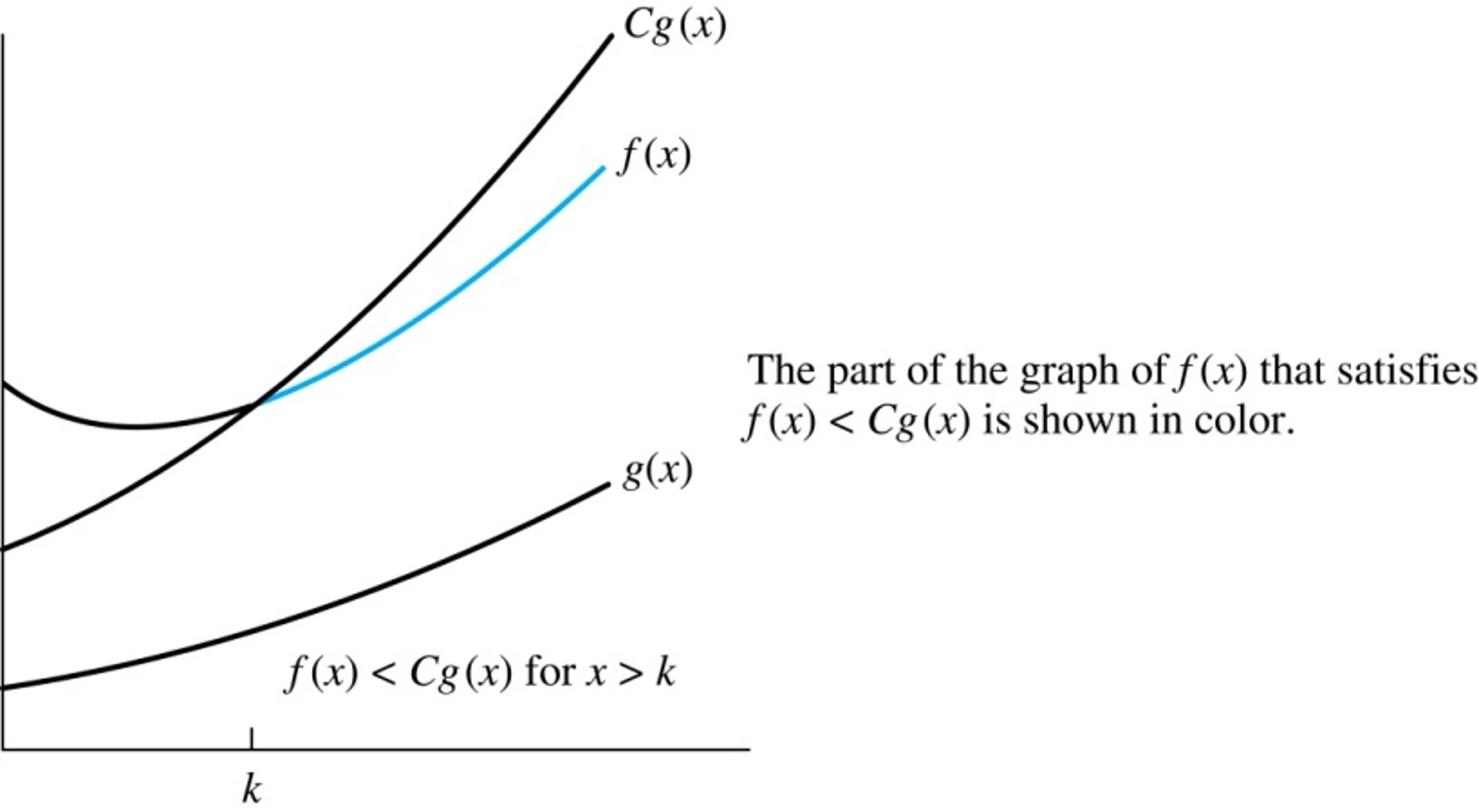
Big-O notation
Let f and g be functions from the set of integers or the set of
real numbers to the set of real numbers.
We say that
$f(x)$ is $O(g(x))$
if there are
constants C and k such that $|f(x)| \leq C|g(x)|$ whenever $x
> k$.
- Yes, since \(17x+11\leq17x+x=18x\leq18x^2\) for all \(x>11\), \(C = 18, k = 11\).
- Yes, since \(x^2+1000\leq x^2+x^2=2x^2\) for all \(x>\sqrt{1000}\), \(C = 2, k = \sqrt{1000}\).
- Yes, since \(xlogx\leq x\cdot x=x^2\) for all \(x\), \(C = 1, k = 0\).
- No, If there were a constant \(C\) such that \(x^4/2\leq Cx^2 \) for sufficiently large \(x\), then we would have \(C\geq x^2/2\).
- No, If \(2^x\) were \(O(x^2)\), then the fraction \(2^x/x^2\) would have to be bounded above by some constant \(C\).
- Yes, since \(\lfloor x \rfloor \lceil x \rceil\leq x(x+1)\leq x\cdot2x = 2x^2\) for all \(x>1\), C = 2, k = 1.
問題3
page 241, Section 3.3 Exercise 2
Give a big-O estimate for the number additions used in this
segment of an algorithm.
                t := 0
                for i := 1 to n
                for j := 1 to n
                t := t + i + j
問題3
page 241, Section 3.3 Exercise 2
Give a big-O estimate for the number additions used in this
segment of an algorithm.
                t := 0
                for i := 1 to n
                for j := 1 to n
                t := t + i + j
The statement
\(t := t + i + j\) is executed \(n^2\) times, so the number of
operations is \(O(n^2)\).